
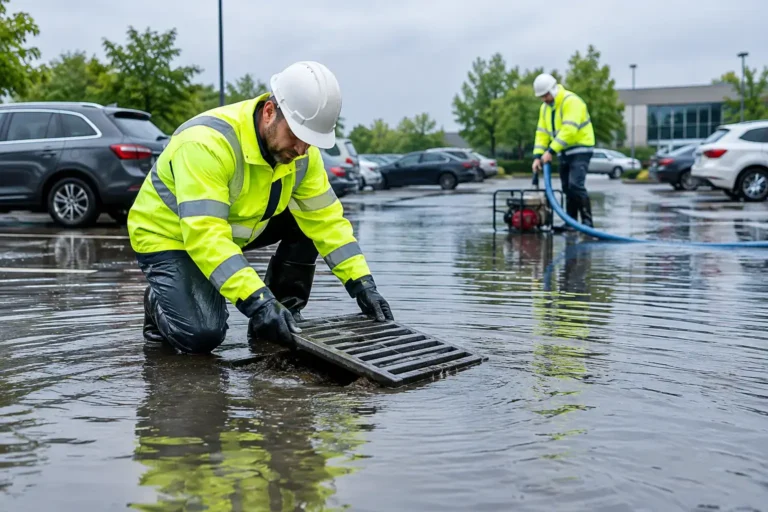
A parking area can look fine on a clear morning and become a safety concern after one hard South Florida rain. Understanding what causes parking flooding helps property owners address the source of standing water before it damages pavement, disrupts access, or creates a liability issue for customers, residents, and employees.
Flooding is rarely caused by rain alone. A properly designed, well-maintained parking lot is built to move water away from driving lanes, parking spaces, buildings, and pedestrian routes. When that system is blocked, worn out, undersized, or incorrectly graded, water finds the lowest point and stays there.
What Causes Parking Flooding Most Often?
The most common cause is poor drainage. Water needs a defined path across the pavement and into drains, swales, retention areas, or another approved outlet. If the lot has little slope, uneven surfaces, or damaged drainage structures, rainfall can collect faster than it can drain.
This problem may be obvious after a storm, but the warning signs often appear earlier. Puddles that remain long after rain stops, algae along curbs, crumbling asphalt near drains, and water marks on nearby walls all suggest that the drainage system needs attention.
Improper or failing pavement slope
Parking lots are graded with subtle slopes that guide water toward drains. Even a small error in elevation can leave a low area where water pools. Settlement over time can create the same issue, especially in areas with heavy vehicle traffic, weak base material, or previous patchwork repairs.
A new layer of asphalt or concrete does not automatically solve a grading problem. If the surface is overlaid without correcting the base or reestablishing proper slope, water may continue to collect – sometimes in a different part of the lot. The right repair depends on the extent of the low area and the condition below the pavement.
Clogged or damaged drains
Catch basins, trench drains, curb inlets, and pipes can fill with leaves, soil, litter, mulch, and sediment. In South Florida, storm debris and fast-moving rainfall can overwhelm a drain that has not been cleaned regularly. A blocked inlet may make a parking lot appear to flood suddenly, even though the rest of the drainage system is in good condition.
Damaged grates, collapsed pipes, broken basin walls, and separated pipe connections can also stop water from moving as designed. These issues are not always visible from the surface. Professional inspection may be needed when flooding continues despite cleaning the drain opening.
Cracked pavement and deteriorated base material
Cracks let water enter the pavement structure. Once moisture reaches the base underneath asphalt or concrete, it can soften or wash away supporting material. The result is a cycle: the surface settles, water pools in the depression, and more water enters the pavement.
Potholes, alligator cracking, and sinking around drain structures should not be treated as cosmetic concerns. They can point to a drainage-related failure beneath the surface. Timely repair protects the investment in the entire parking area and reduces the chance that a small patch becomes a larger reconstruction project.
Inadequate drainage for the size of the property
Older lots may have been built for less paved area, fewer buildings, or lower stormwater demands. A property expansion, new landscaping, adjacent construction, or changes to nearby drainage patterns can direct more runoff toward the lot than its original system can handle.
Drainage capacity matters as much as drain location. One small inlet may handle routine showers but fail during a heavy downpour. In those cases, the solution may involve additional catch basins, improved pipe sizing, regrading, or a coordinated civil work plan that directs water safely off the pavement.
Blocked flow from curbs and landscaping
Curbs are useful for guiding traffic and protecting landscaped areas, but they also control where water can travel. If curb openings are missing, clogged, or placed too high, runoff can become trapped in parking stalls or drive lanes.
Landscaping can contribute as well. Overgrown roots may damage pavement, while loose mulch and soil can wash into drains. Raised planting beds or newly installed hardscape may unintentionally redirect water. The goal is not to remove landscaping, but to make sure it works with the drainage design rather than against it.
Why Standing Water in a Parking Lot Should Be Addressed Quickly
Flooding affects more than appearance. Water-covered potholes, slippery algae, and hidden curbs increase the risk of vehicle damage, trips, and falls. For commercial properties, a flooded entrance or parking aisle can make customers turn away before they reach the building.
Water also shortens pavement life. Asphalt is particularly vulnerable when water repeatedly reaches the base layer, while concrete can crack or shift when supporting soils erode. Near buildings, poorly directed runoff can place added pressure on foundations, walkways, doors, and exterior walls.
There is a practical business concern, too. Repeated flooding can lead to emergency repairs, disrupted operations, tenant complaints, and avoidable maintenance costs. Addressing drainage early is usually more predictable and less disruptive than waiting for pavement failure or a major storm event.
How to Identify the Source of Parking Flooding
Start by observing the lot after rainfall and again several hours later. Take note of where water first collects, whether it reaches entrances or sidewalks, and how long it remains. Water that drains slowly from a low point may indicate a grading issue. Water that rises around an inlet may point to a clogged or undersized drain.
Look beyond the puddle itself. Check for cracks radiating from the area, depressions in the pavement, loose asphalt, eroded edges, and damaged curbs. Also consider where water enters the property. Roof downspouts, neighboring lots, driveway entrances, and landscaped areas may all send runoff toward the same location.
For a commercial property or a large residential parking area, a site assessment is the most reliable next step. An experienced paving and civil works team can evaluate slope, drainage structures, pavement condition, and the likely path of runoff. This makes it possible to recommend a repair that solves the cause rather than simply covering the visible damage.
Parking Flooding Repairs That Match the Problem
There is no single fix for every flooded parking lot. Cleaning drains and removing debris may be enough when the system is sound but neglected. When pavement has settled, localized removal and replacement may be needed to rebuild the base and restore proper slope.
More extensive flooding may require regrading sections of the lot, repairing or replacing catch basins, installing new drainage lines, or improving curb and inlet layouts. If water is entering from outside the property, the work may need to account for site-wide drainage and local requirements.
Choosing the least expensive visible repair can be tempting, especially when a puddle affects only a few spaces. But a surface patch can fail quickly if the base remains saturated or the drain remains blocked. The best value comes from matching the scope of work to the actual source of water.
Preventive Maintenance Protects Pavement and Access
Regular attention can prevent many drainage issues from becoming costly repairs. Drain inlets should be kept clear, especially before the rainy season and after major storms. Pavement should be inspected for cracks, settlement, and areas where water regularly collects.
Property managers should also monitor any changes around the site. New construction, roof drainage modifications, fresh landscaping, and utility work can alter runoff patterns. Keeping a record of recurring flood locations helps maintenance teams and contractors identify patterns instead of responding to each storm as an isolated event.
For properties in Miami-Dade, Broward, and Palm Beach counties, heavy rain is part of the operating environment. Castellón Services Corp. can help evaluate pavement, drainage, and site conditions with a practical focus on safety, durability, and long-term performance.
A dry, accessible parking area supports every part of a property – from curb appeal and customer access to pavement life and day-to-day safety. When water keeps returning to the same spot, treat it as a signal to investigate now, before the next storm turns a manageable repair into a larger problem.