
A driveway should carry vehicles, not carry stormwater toward your garage, home, or neighboring property. Effective driveway drainage solutions manage where rain goes before it can soften the base beneath pavement, create slippery standing water, or leave stains and washouts behind. In South Florida, a short period of heavy rain can expose grading and drainage problems that stayed hidden during dry weather.
Water damage is rarely limited to one puddle. When runoff repeatedly crosses or collects on a driveway, it can erode soil, undermine concrete or pavers, and direct moisture toward the foundation. The right repair starts with understanding the source of the water and the path it needs to follow.
Why Driveway Drainage Problems Need Prompt Attention
A driveway is built in layers. Beneath the visible concrete, asphalt, or pavers is a compacted base that provides stability. Water that reaches and remains in that base can weaken it over time. With concrete, this may lead to cracking, settlement, or uneven slabs. With pavers, it can cause sinking sections, shifting joints, and loss of sand. Asphalt may develop depressions, edge failure, or potholes.
The most obvious warning sign is standing water that remains long after rainfall stops. However, drainage issues also show up as recurring algae growth, muddy tracks near the driveway edge, loose pavers, soil washing from planting beds, or water entering the garage. A driveway that slopes toward the street can still have a problem if its low point traps water before it reaches the curb.
For commercial properties, the stakes are higher. Ponding water in an entrance drive, loading area, or parking lot creates a slip risk, affects accessibility, and can interrupt normal operations. Addressing drainage as part of paving maintenance protects both the surface and the people who use it.
Start With the Cause, Not the Visible Puddle
The best drainage system depends on the conditions of the site. Installing a drain where water collects may help, but it will not solve the problem if the surrounding pavement continues to direct water the wrong way. A qualified assessment should look at the entire drainage path, from roof runoff and landscape grades to the driveway surface and approved discharge point.
Incorrect driveway slope
Driveways need positive drainage, meaning water naturally moves away from structures and toward a planned outlet. A driveway can be generally sloped yet still hold water because of a shallow low area, settling, poor transitions at the sidewalk, or an improper tie-in at the garage.
Correcting the slope may require resurfacing, replacing a section of concrete, resetting pavers, or rebuilding the base in a failed area. This is often the most durable option when the surface itself is the source of the problem. Adding drainage components without correcting a major slope issue can lead to repeated repairs.
Roof runoff and downspout discharge
A downspout that empties onto the driveway concentrates a surprising volume of water in one location. It can create erosion along the edge, stain the pavement, and push runoff toward the garage. Extending or redirecting the discharge can be a simple part of the solution, but the water still needs a safe place to go.
Downspout drainage should not be directed onto a neighbor’s property or simply moved closer to the foundation. Depending on the property layout, it may connect to a properly designed underground drain, daylight at a suitable location, or discharge into an approved system.
Landscape and adjacent-grade changes
New mulch beds, raised planters, pool decks, walkways, and retaining features can unintentionally redirect water. Even a small change along a driveway edge may form a dam that prevents water from leaving the pavement. This is why drainage planning should be part of larger exterior improvements, not an afterthought once the work is complete.
Driveway Drainage Solutions for Different Conditions
There is no single drain that works for every property. The right option balances water volume, available slope, surface material, property layout, maintenance needs, and local requirements.
Channel drains at garage entrances and low points
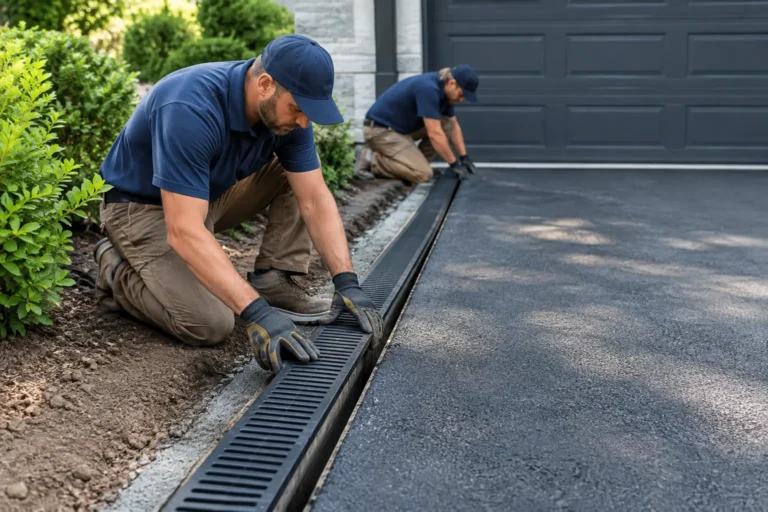
A channel drain, also called a trench drain, is a narrow linear drain set across a driveway. It is especially useful immediately in front of a garage door, at the bottom of a sloped drive, or between a driveway and a patio where runoff needs to be intercepted before it reaches a building.
The drain grate collects water along its length and sends it through a connected pipe to an approved discharge location. Channel drains are effective because they do not rely on water finding one small opening. They must be installed at the correct elevation, with a stable concrete surround and a properly pitched outlet pipe. A drain without a workable outlet only relocates the standing water.
Catch basins for concentrated runoff
A catch basin is a box-shaped inlet with a grate at the surface. It works well at a defined low point where runoff naturally concentrates, such as the corner of a parking area or the edge of a driveway. The basin collects water and debris before moving water into underground piping.
Catch basins are practical, but they require regular cleaning. Leaves, mulch, sediment, and trash can block the grate or fill the basin. They are best suited to locations where the site grading reliably directs water to a single point.
Regrading and surface reconstruction
When settlement, poor original installation, or long-term erosion has changed the driveway profile, regrading is often the better investment. The work may involve removing damaged pavement, rebuilding and compacting the base, and installing a new surface with the correct pitch.
This approach has a larger upfront cost than placing a drain alone, but it addresses the structural cause of water retention. It is particularly valuable for driveways with widespread cracking, recurring low spots, or pavers that have shifted across a large area.
French drains and subsurface drainage
A French drain uses perforated pipe surrounded by drainage stone and filter fabric to collect water below ground. It is commonly used along a driveway edge where saturated soil, landscape runoff, or groundwater is contributing to erosion or soggy conditions.
French drains are not designed to replace proper surface grading. They work best as a supporting system that relieves subsurface water and protects the driveway base. If the main issue is rainwater flowing across the pavement, a surface drain or slope correction is usually more effective.
Swales and permeable areas
Where the property has adequate space, a shallow vegetated swale or landscaped collection area can slow and direct runoff while reducing the amount of hard surface draining into one location. This can be an attractive option for larger residential lots and certain commercial sites.
Permeable pavers may also help manage rainwater, but they require a correctly designed stone base and ongoing maintenance to prevent the joints from clogging. They are not automatically the right choice for every driveway, especially where soil conditions, traffic loads, or drainage restrictions call for a more conventional system.
Installation Details That Make the Difference
Drainage performance depends on more than choosing a drain style. The pipe needs enough slope to move water. Connections must be secure. Grates need to sit flush with the finished surface so tires, foot traffic, and runoff pass over them safely. The surrounding pavement must be properly supported to reduce cracking at the drain line.
Discharge planning is equally important. Water should move to a lawful, functional outlet that does not cause erosion or shift a problem to another part of the property. Local drainage rules, utility locations, elevation changes, and existing stormwater systems can all affect the design. For commercial work, site plans and code requirements may also determine the appropriate approach.
A professional contractor can coordinate the paving, concrete, excavation, and drainage portions of the project as one scope. That coordination matters because a new drain installed after the driveway is complete may require cutting into finished pavement and repairing seams that could have been avoided through early planning.
Maintenance Keeps Drainage Working
Even a well-designed system needs routine attention. After heavy storms, check whether water is moving freely through channel drains and catch basins. Remove leaves, sand, and landscape debris from grates. Watch for soil erosion around discharge points, and repair cracked pavement or separated joints before runoff reaches the base.
For properties with pavers, inspect low areas and joints regularly. Replacing lost joint sand and correcting small areas of movement early can prevent a minor drainage concern from becoming a larger reconstruction project. Commercial property managers should include drain cleaning and visual inspections in their regular exterior maintenance schedule, particularly before the rainy season.
The most reliable result is a driveway that looks clean, drains quickly, and protects the structures around it without creating a new problem elsewhere. When water is already pooling, washing out edges, or reaching a garage, a site-specific evaluation can clarify whether the answer is regrading, a channel drain, underground piping, or a combination of solutions. Castellón Services Corp. can help property owners plan driveway improvements that put durable workmanship and practical drainage first.